Proportions in Finance: Interest, Currency & Tax Ratios
Use proportions to calculate simple interest, compare loans, convert currency, split a portfolio, find ROI and work out sales tax, step by step.
By Proportions Calculator Team · Updated
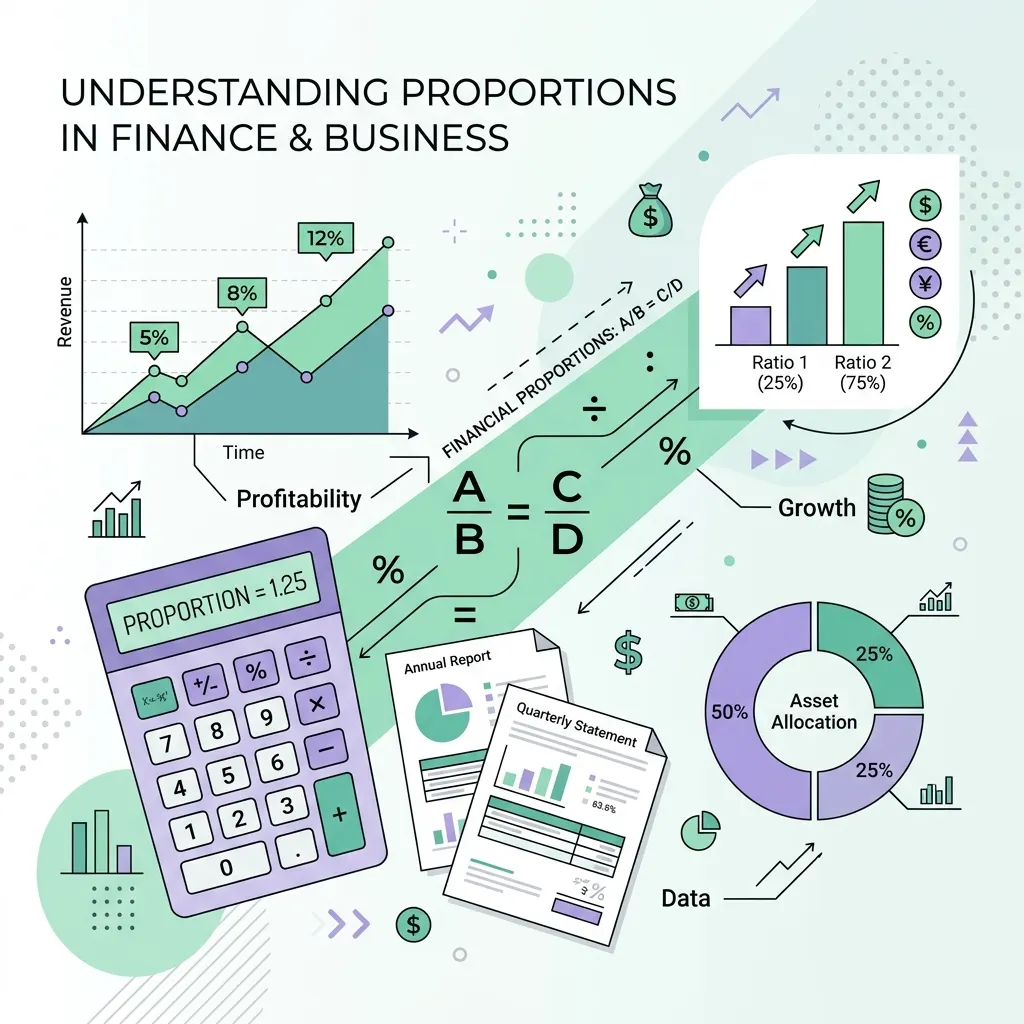
Why Finance Is All About Proportions
At its core, finance is the science of proportional relationships. Interest rates, tax brackets, investment returns, currency exchange rates, and profit margins — they’re all ratios. Understanding how proportions work gives you a powerful edge in managing your money.
Interest Rate Calculations
Simple Interest
Simple interest is a direct proportion. If a savings account earns $50 on a $1,000 deposit in one year, how much would a $3,500 deposit earn?
1000/50 = 3500/x → x = $175
Comparing Loan Offers
Proportions help you compare financial products fairly. If Bank A charges $240 interest on a $4,000 loan and Bank B charges $375 on a $6,000 loan:
- Bank A rate: 240/4000 = 6%
- Bank B rate: 375/6000 = 6.25%
Bank A offers the better deal — something that might not be obvious just looking at the dollar amounts.
Currency Exchange
Currency conversion is pure proportional math. If 1 USD = 83.5 Indian Rupees:
1/83.5 = 250/x → x = 20,875 INR
Multi-Currency Conversions
Traveling through multiple countries? Chain your proportions:
- USD to EUR: 1/0.92 = 500/x → x = 460 EUR
- EUR to GBP: 1/0.86 = 460/x → x = 395.60 GBP
- GBP to JPY: 1/192 = 395.60/x → x = 75,955 JPY
Investment Returns
Portfolio Allocation
The classic 60/40 rule (60% stocks, 40% bonds) is a proportion:
- $50,000 portfolio:
- Stocks: 60/100 = x/50000 → x = $30,000
- Bonds: 40/100 = x/50000 → x = $20,000
Return on Investment (ROI)
If an investment of $2,000 returned $2,340 in one year:
- Profit: $340
- ROI proportion: 340/2000 = x/100 → x = 17% return
Tax Calculations
Sales Tax
If the sales tax is 8.5%, what’s the tax on a $1,250 purchase?
8.5/100 = x/1250 → x = $106.25
Income Tax Brackets
Understanding proportions helps you estimate taxes across brackets:
| Income Range | Rate | On $75,000 Salary |
|---|---|---|
| $0 – $11,000 | 10% | $1,100 |
| $11,001 – $44,725 | 12% | $4,047 |
| $44,726 – $75,000 | 22% | $6,660 |
| Total Tax | $11,807 |
The effective tax rate: 11807/75000 = x/100 → x = 15.7%
Budgeting with Proportions
The 50/30/20 Rule
A popular budgeting framework based on proportions:
- 50% Needs: Housing, food, insurance
- 30% Wants: Entertainment, dining out, hobbies
- 20% Savings: Emergency fund, retirement, investments
For a $4,500 monthly income:
- Needs: 50/100 = x/4500 → x = $2,250
- Wants: 30/100 = x/4500 → x = $1,350
- Savings: 20/100 = x/4500 → x = $900
Debt-to-Income Ratio
Lenders use the debt-to-income (DTI) ratio to evaluate loan applications. If your monthly debt payments are $1,200 and your gross monthly income is $5,000:
1200/5000 = x/100 → x = 24% DTI
Most lenders prefer a DTI below 36%.
Profit Margins in Business
Calculating Markup
If a product costs $45 to produce and you want a 40% markup:
40/100 = x/45 → x = $18 markup → Selling price = $63
Gross Profit Margin
Revenue of $150,000 with cost of goods at $90,000:
Gross profit: $60,000 Margin: 60000/150000 = x/100 → x = 40%
Key Financial Ratios
Smart investors track these proportional metrics:
- Price-to-Earnings (P/E): Stock price / Earnings per share
- Debt-to-Equity: Total debt / Shareholder equity
- Current Ratio: Current assets / Current liabilities
- Quick Ratio: (Cash + Receivables) / Current liabilities
Try It Yourself
Financial math doesn’t have to be intimidating. Use our Proportions Calculator to instantly solve any financial proportion — from currency conversions to ROI calculations. Enter three known values and get your answer with step-by-step verification.
Related Articles
- Cross-Multiplication Explained: The Fastest Way to Solve Proportions — Master the math behind financial ratio calculations
- Getting Started with Proportions: A Complete Guide — New to proportions? Start here with the fundamentals
- How Architects and Engineers Use Proportions Every Day — See proportions in another professional field
- Proportions in Cooking: How to Scale Any Recipe Like a Pro — Proportions aren’t just for finance — they’re in the kitchen too
Solve your own proportion
Enter any three values in our free proportion calculator and get the missing value with step-by-step cross-multiplication.
Open the Proportion Calculator →Related Articles
Proportions in Architecture: Scale Drawings & Golden Ratio
How architects use proportions: reading 1:50 blueprints, the golden ratio (1:1.618), material scaling, concrete mix ratios and scale models, with examples.
How to Scale a Recipe Using Proportions (Easy Method)
Scale any recipe with one proportion: divide new servings by original servings, then multiply every ingredient. Worked examples and a conversion table.
Proportions in Chemistry: Dilutions (C1V1=C2V2) & Moles
How chemists use proportions for dilutions (C1V1 = C2V2), mole ratios in stoichiometry and weight-based dosing — with clear, step-by-step worked examples.