Proportions in Architecture: Scale Drawings & Golden Ratio
How architects use proportions: reading 1:50 blueprints, the golden ratio (1:1.618), material scaling, concrete mix ratios and scale models, with examples.
By Proportions Calculator Team · Updated
The Foundation of Design: Proportional Thinking
Architecture and engineering are built on proportions — literally. Every building you see started as a scaled-down drawing where precise ratios ensured that the final structure would be exactly right. Without proportional math, bridges would collapse, buildings would lean, and designs would fail.
Scale Drawings and Blueprints
The most fundamental use of proportions in architecture is the scale drawing. A blueprint might use a scale of 1:50, meaning every 1 centimeter on the drawing represents 50 centimeters in real life.
Example: Reading a Blueprint
If a room measures 8 cm × 6 cm on a 1:50 blueprint:
- Real width: 1/50 = 8/x → x = 400 cm (4 meters)
- Real length: 1/50 = 6/x → x = 300 cm (3 meters)
Common architectural scales include:
| Scale | Use Case |
|---|---|
| 1:20 | Detailed sections, joinery |
| 1:50 | Floor plans, elevations |
| 1:100 | Site plans, large buildings |
| 1:500 | Urban planning, master plans |
The Golden Ratio in Architecture
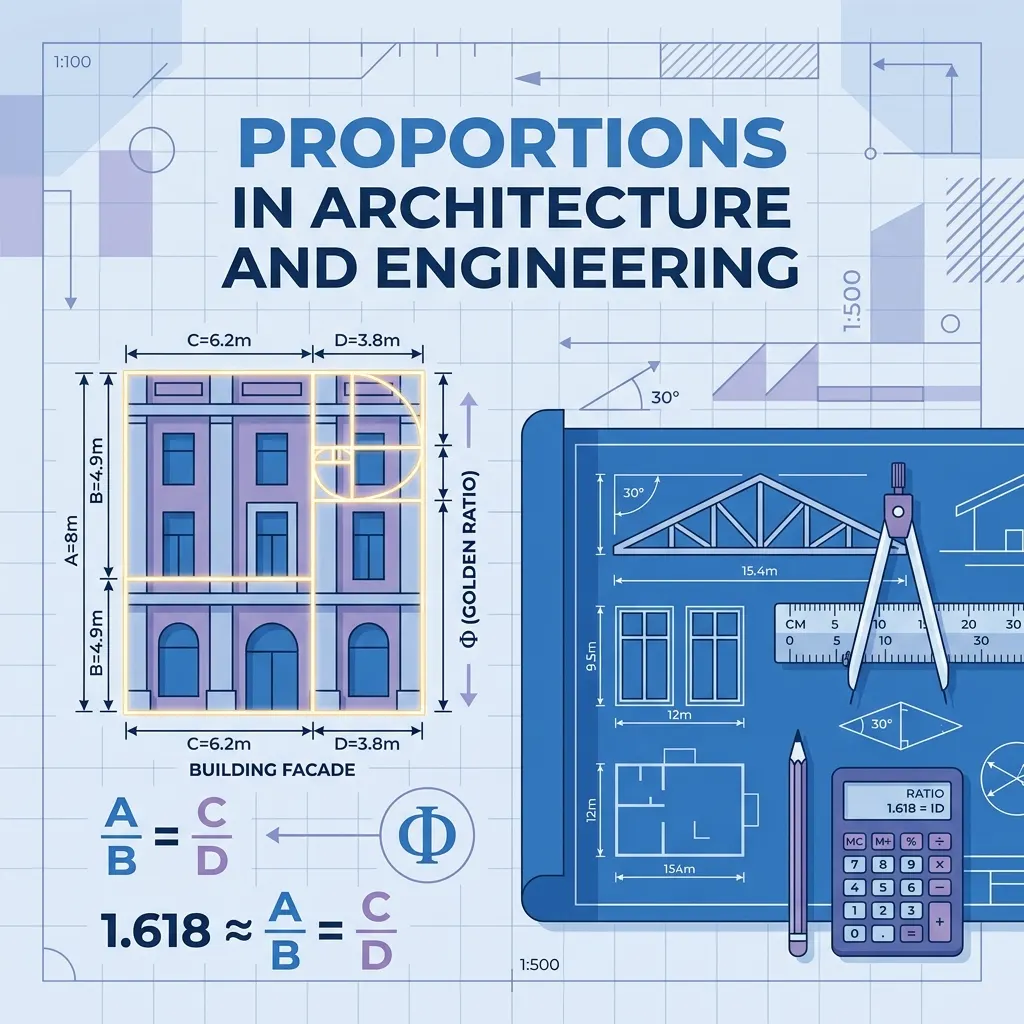
The golden ratio (approximately 1:1.618) has been used in architecture for thousands of years. It creates naturally pleasing proportions that the human eye finds beautiful.
Famous buildings that use the golden ratio:
- The Parthenon (Athens) — The facade’s width-to-height ratio closely approximates φ
- Notre-Dame Cathedral (Paris) — The facade is organized around golden rectangles
- United Nations Headquarters (New York) — The building’s proportions reflect the golden ratio
- The Great Pyramid of Giza — The ratio of slant height to half-base approximates φ
Calculating the Golden Ratio
If you want a room to feel perfectly proportioned:
- Width: Choose any measurement (e.g., 5 meters)
- Length: 1/1.618 = 5/x → x = 8.09 meters
Structural Engineering and Load Calculations
Engineers use proportions constantly when calculating loads, stresses, and material requirements:
Material Scaling
If a steel beam 10 meters long requires 500 kg of steel, how much does a 15-meter beam require?
10/500 = 15/x → x = 750 kg
Concrete Mixing Ratios
Standard concrete mix proportions:
- General purpose: 1 part cement : 2 parts sand : 3 parts gravel (1:2:3)
- High strength: 1 part cement : 1.5 parts sand : 2.5 parts gravel
- Foundation work: 1 part cement : 2.5 parts sand : 3.5 parts gravel
Model Building
Architects build physical models at specific scales. If an architect is building a 1:200 model of a 60-meter-tall building:
1/200 = x/6000 cm → x = 30 cm tall
Every window, door, and structural element must maintain the same proportion to look realistic.
Modern Applications
Today’s architects use proportions in:
- 3D modeling software — Parametric design relies on proportional relationships
- Sustainable design — Window-to-wall ratios affect energy efficiency
- Acoustic engineering — Room proportions determine sound quality
- Accessibility compliance — Ramp slopes must maintain specific ratios (1:12 max)
Try It Yourself
Whether you’re designing a building, reading a blueprint, or calculating material quantities, our Proportions Calculator makes the math instant. Enter your scale ratio and known measurement to find any unknown dimension.
Related Articles
- Getting Started with Proportions: A Complete Guide — Learn the fundamentals of proportional math
- Cross-Multiplication Explained — Master the technique behind scale calculations
- Proportions in Cooking: How to Scale Any Recipe Like a Pro — Another real-world application of proportional math
- Proportions in Finance: Master Ratios for Smarter Money Decisions — See how proportions power financial decisions
Solve your own proportion
Enter any three values in our free proportion calculator and get the missing value with step-by-step cross-multiplication.
Open the Proportion Calculator →Related Articles
Proportions in Finance: Interest, Currency & Tax Ratios
Use proportions to calculate simple interest, compare loans, convert currency, split a portfolio, find ROI and work out sales tax, step by step.
How to Scale a Recipe Using Proportions (Easy Method)
Scale any recipe with one proportion: divide new servings by original servings, then multiply every ingredient. Worked examples and a conversion table.
Proportions in Chemistry: Dilutions (C1V1=C2V2) & Moles
How chemists use proportions for dilutions (C1V1 = C2V2), mole ratios in stoichiometry and weight-based dosing — with clear, step-by-step worked examples.