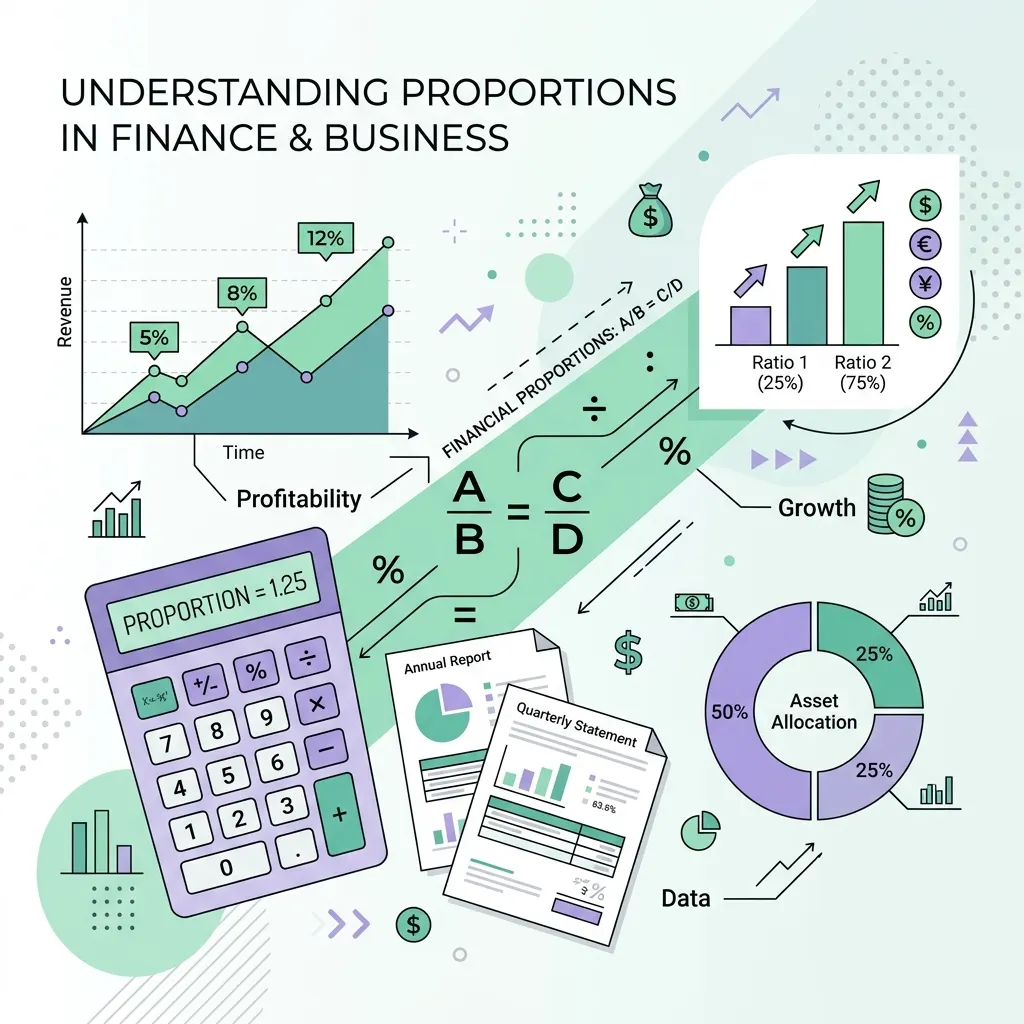
Proportions in Finance: Interest, Currency & Tax Ratios
Use proportions to calculate simple interest, compare loans, convert currency, split a portfolio, find ROI and work out sales tax, step by step.
Read ArticleFree proportion solver: enter any three values of A/B = C/D to find the missing one, with step-by-step cross-multiplication. Enter all four to check whether two ratios form a proportion.
Start CalculatingEnter any three known values and leave one field empty (or type x) to find the unknown. Fill in all four to check if the ratios are proportional.
To solve a proportion a/b = c/d, cross-multiply so that a × d = b × c, then divide the known cross product by the number paired with the unknown. For example, in 3/4 = x/12: 3 × 12 = 4 × x, so 36 = 4x and x = 9.
A proportion is a mathematical equation that states two ratios are equal. It is written in the standard form A/B = C/D, where A, B, C, and D are numbers called the terms of the proportion. The proportion declares that the ratio A:B has the same value as the ratio C:D.
A proportion has 4 key components: the first ratio (A/B), the second ratio (C/D), the means (B and C — the two inner terms), and the extremes (A and D — the two outer terms). The fundamental property of proportions states that the product of the means equals the product of the extremes: B × C = A × D.
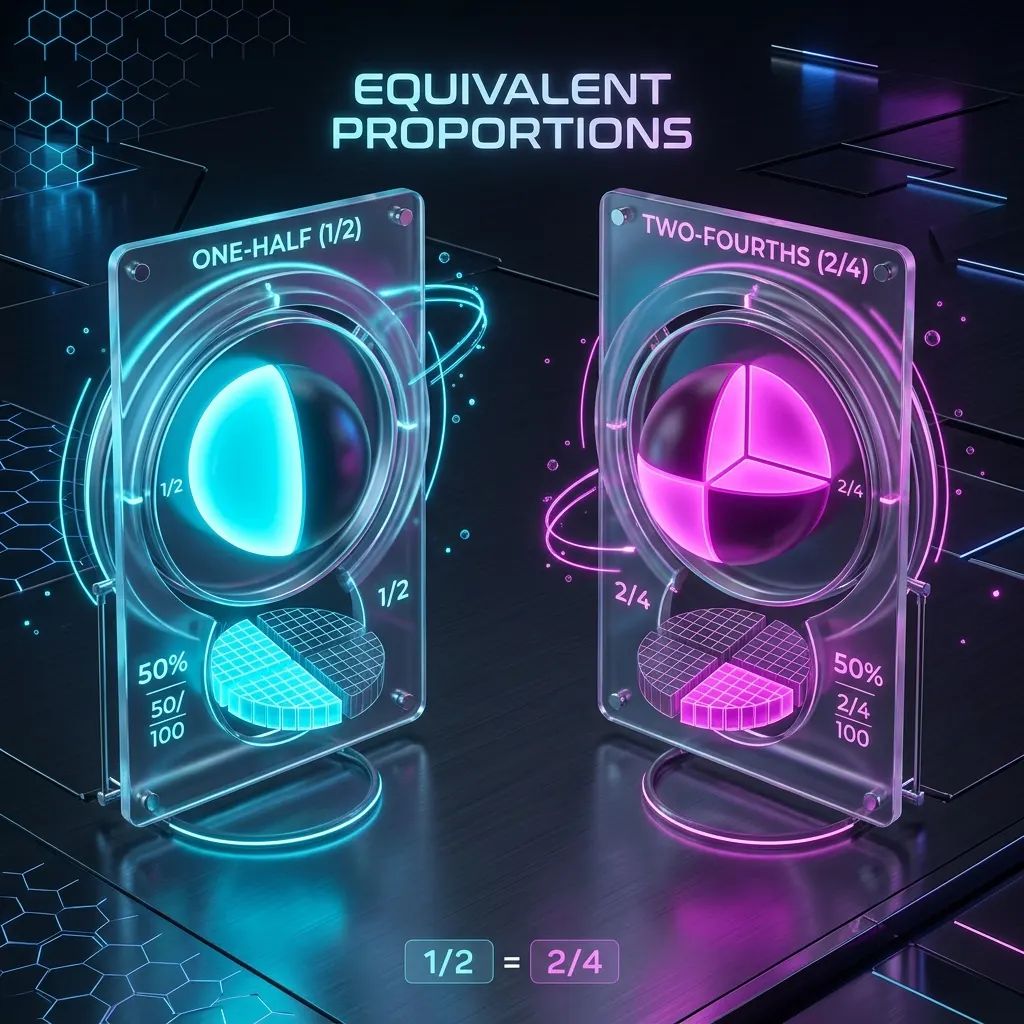
For example, 2/3 = 4/6 is a proportion because both ratios simplify to the same value (0.667). You can verify this by cross-multiplication: 2 × 6 = 12 and 3 × 4 = 12. Since both products are equal, the proportion is true.
A Proportions Calculator is an online math tool that solves for the missing variable in a proportion of the form A/B = C/D.
A Proportions Calculator is a free online tool that takes three known values and computes the fourth (unknown) value using the cross-multiplication method. The Proportions Calculator has 3 primary components: input fields for entering the known values of A, B, C, and D, a calculate button that triggers the cross-multiplication formula, and a result display that shows the solved value with a step-by-step solution breakdown.
The Proportions Calculator serves 4 main purposes: solving homework and textbook proportion problems, scaling recipes in cooking, converting measurements between units, and verifying whether two given ratios form a true proportion. The calculator handles integers, decimals, and negative numbers, making it suitable for all standard proportion problems.
Follow these 3 steps to solve any proportion problem instantly.
Input any three known numbers into the A, B, C, D fields. Leave the unknown field empty or type x.
The proportion formula A × D = B × C is applied automatically to solve for the missing value.
Instantly see the answer with step-by-step solution breakdown and cross-multiplication verification.
To solve a proportion, use the cross-multiplication method. In the proportion A/B = C/D, cross-multiplication states that A × D = B × C. When one of the four values is unknown, rearrange the equation to isolate the unknown variable:
The cross-multiplication method works because if two fractions are equal, then their cross products must also be equal. This principle is the foundation of all proportion solving — whether in algebra, geometry, chemistry, or everyday applications like recipe scaling.
Two ratios form a proportion only if their cross products are equal. Enter all four numbers in the calculator above to check any pair instantly.
To test whether a:b and c:d form a proportion, multiply the extremes (a × d) and the means (b × c). If the two products are equal, the ratios are proportional; if not, they are not. You can also divide each ratio and compare the decimals.
| Ratios | Cross products | Proportion? |
|---|---|---|
| 16:8 and 6:3 | 16 × 3 = 48, 8 × 6 = 48 | Yes — both equal 2:1 |
| 2:5 and 6:15 | 2 × 15 = 30, 5 × 6 = 30 | Yes — both equal 0.4 |
| 3:4 and 5:6 | 3 × 6 = 18, 4 × 5 = 20 | No — 0.75 ≠ 0.833 |
| 7:2 and 21:6 | 7 × 6 = 42, 2 × 21 = 42 | Yes — both equal 3.5 |
Need more? Use the cross multiplication calculator or the equivalent ratio calculator.
If y ÷ x is the same for every pair of values, the relationship is proportional and that value is k.
In a proportional relationship, y = kx, where k is the constant of proportionality (also called the unit rate). To find k, divide any y-value by its matching x-value: k = y ÷ x.
A table, graph or equation is proportional only if k is the same for every pair and the graph is a straight line through the origin (0, 0). For example, if 2 hours of work earns $30 and 5 hours earns $75, then k = 30 ÷ 2 = 75 ÷ 5 = 15, so pay = 15 × hours.
Find k for your own values with the direct proportion calculator — it shows the equation, a value table and a graph.
There are 3 main types of proportions used in mathematics and real-world applications.
In a direct proportion, two quantities increase or decrease together at the same rate. The formula is y = kx, where k is the constant of proportionality.
In an inverse proportion, one quantity increases as the other decreases. The formula is x × y = k, where k is a constant.
A compound proportion involves more than two quantities that are related proportionally. It combines multiple direct or inverse proportions into a single problem.
Click any example to auto-fill the calculator and see the solution.
Here are 5 detailed examples showing how to solve proportions step by step using cross-multiplication.
A recipe calls for 3 cups of flour for 4 servings. You want to make 12 servings. How many cups of flour do you need?
On a map, 15 cm represents 12 km. How many km does 5 cm represent?
A chemical solution requires 21 mL of solute per 9 mL of solvent. How much solvent do you need for 7 mL of solute?
A 1.8 m tall person casts a 2.4 m shadow. At the same moment, a tree casts a 16 m shadow. Because the sun's rays form similar triangles, height and shadow are proportional. How tall is the tree?
A paint mix uses 1/2 cup of blue for every 3/4 cup of white. How much blue do you need for 9 cups of white? Type the fractions straight into the calculator as 1/2 and 3/4, or use the proportion calculator with fractions for an exact fraction answer.
Try these common textbook problems, then check your work with the calculator.
| Problem | Cross-multiplication | Answer |
|---|---|---|
| b/36 = 5/9 | 9b = 36 × 5 = 180 | b = 20 |
| 13 : x = 3.25 : 8 | 3.25x = 13 × 8 = 104 | x = 32 |
| 5/8 = 15/x | 5x = 8 × 15 = 120 | x = 24 |
| x/12 = 2.5/4 | 4x = 12 × 2.5 = 30 | x = 7.5 |
| 2/3 = 10/x | 2x = 3 × 10 = 30 | x = 15 |
| x/45 = 4/9 | 9x = 45 × 4 = 180 | x = 20 |
| Do 16:8 and 6:3 form a proportion? | 16 × 3 = 48 = 8 × 6 | Yes |
Check any answer with the calculator above or the ratio calculator.
Proportions are used everywhere in daily life. Here are 6 common real-world applications of proportional reasoning.
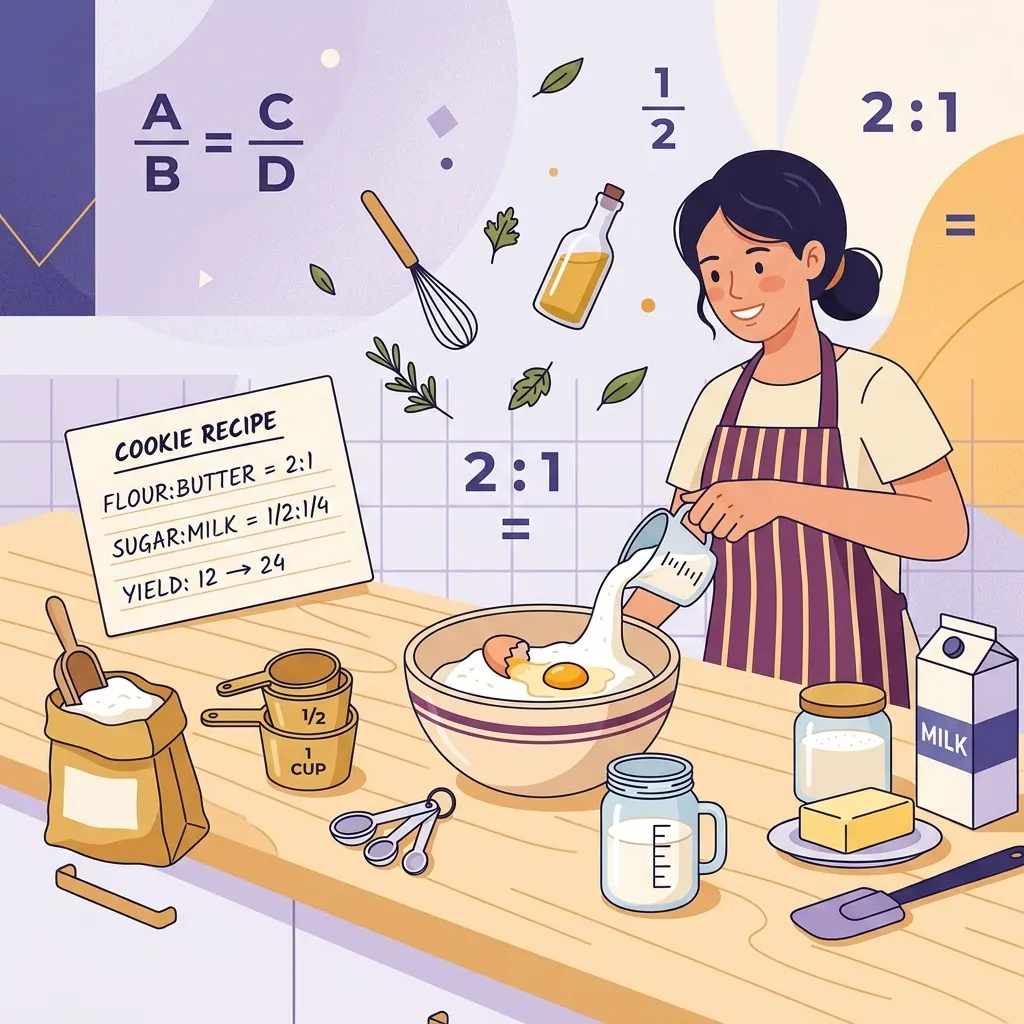
Scale recipes up or down using proportions. If a recipe for 4 people calls for 2 cups of rice, use the proportion 2/4 = x/8 to find that 8 people need 4 cups.
Convert map distances to real-world distances. If 1 cm on a map represents 5 km, the proportion 1/5 = 3/x tells you that 3 cm equals 15 km.
Convert currencies and calculate interest rates. If $1 equals €0.92, the proportion 1/0.92 = 100/x calculates that $100 equals €92.
Mix chemical solutions in the correct ratios. A solution requiring 3 parts acid to 7 parts water uses the proportion 3/7 to maintain consistency at any volume.
Scale blueprints and calculate material quantities. If a concrete mix uses 1 part cement to 3 parts sand, the proportion 1/3 = 5/x shows 5 bags of cement need 15 bags of sand.
Maintain aspect ratios when resizing images. A photo at 1920×1080 has a 16:9 ratio. The proportion 16/9 = 1280/x gives x = 720 for a scaled-down version.
Key takeaway: A ratio is a single comparison between two numbers, while a proportion is an equation that declares two ratios are equal. Every proportion contains two ratios, but a ratio by itself is not a proportion.
There are 3 main reasons to use a Proportions Calculator instead of solving proportions manually.
A quick reference table of common proportions used in everyday calculations.
| Proportion (A/B = C/D) | Cross Product | Context |
|---|---|---|
| 1/2 = 5/10 | 1×10 = 2×5 = 10 | Halving / doubling |
| 2/3 = 4/6 | 2×6 = 3×4 = 12 | Recipe scaling |
| 3/4 = 9/12 | 3×12 = 4×9 = 36 | Fraction equivalence |
| 5/8 = 10/16 | 5×16 = 8×10 = 80 | Measurement conversion |
| 1/3 = 7/21 | 1×21 = 3×7 = 21 | Simplifying fractions |
| 4/5 = 16/20 | 4×20 = 5×16 = 80 | Percentage (80%) |
| 2/7 = 6/21 | 2×21 = 7×6 = 42 | Ratio scaling |
| 16/9 = 1920/1080 | 16×1080 = 9×1920 = 17280 | Screen aspect ratio |
The calculator above solves A/B = C/D. These are the dedicated tools for every related question — each one shows its working and accepts fractions as well as decimals.
Proportions Solve, verify and model proportional relationships.
Ratios Simplify, scale, share and compare ratios of any length.
Conversions & Rates Turn a ratio into a percentage, decimal, fraction or unit rate.
Explore our educational articles on proportions, ratios, and mathematical problem-solving techniques.
Use proportions to calculate simple interest, compare loans, convert currency, split a portfolio, find ROI and work out sales tax, step by step.
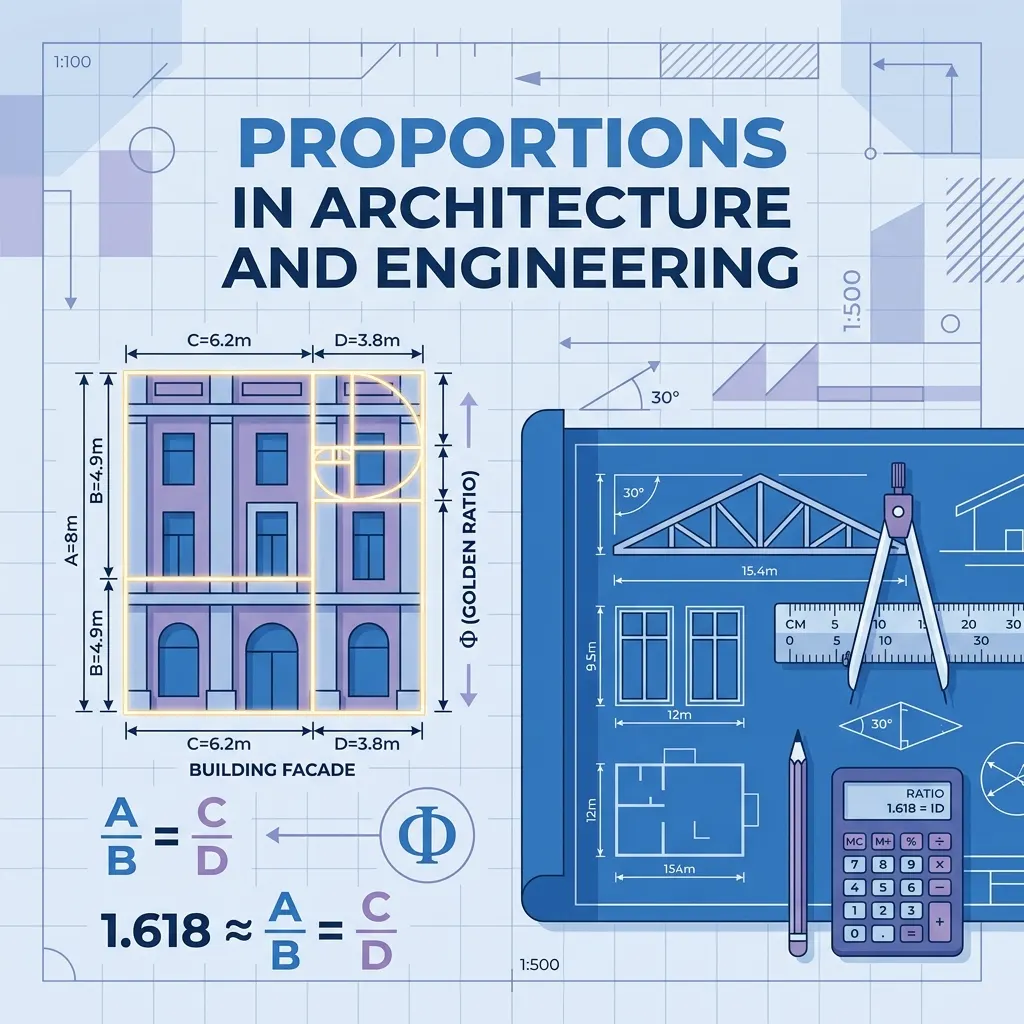
Read ArticleHow architects use proportions: reading 1:50 blueprints, the golden ratio (1:1.618), material scaling, concrete mix ratios and scale models, with examples.
Read ArticleScale any recipe with one proportion: divide new servings by original servings, then multiply every ingredient. Worked examples and a conversion table.
Read ArticleCross-multiplication turns a/b = c/d into a × d = b × c. See why it works, how to solve for x in any position, decimal examples, and the mistakes to avoid.
Read ArticleA proportion is an equation saying two ratios are equal (a/b = c/d). Learn the definition, the cross-multiplication formula, how to solve for x and examples.
Read ArticleHow chemists use proportions for dilutions (C1V1 = C2V2), mole ratios in stoichiometry and weight-based dosing — with clear, step-by-step worked examples.
Read ArticleA proportion is an equation stating that two ratios are equal, written a/b = c/d or a:b = c:d. For example, 2/3 = 4/6 is a proportion because both ratios equal 0.667.
Cross-multiply, then divide. In 3/4 = x/12, cross-multiplying gives 3 × 12 = 4 × x, so 36 = 4x and x = 9. With the calculator, enter the three known values, leave the unknown field empty, and press Calculate.
Cross-multiply to get a × d = b × c, then divide both sides by b: c = (a × d) ÷ b. The other forms are a = (b × c) ÷ d, b = (a × d) ÷ c and d = (b × c) ÷ a.
In a/b = c/d, multiply each numerator by the opposite denominator: a × d = b × c. It works because multiplying both sides of the equation by b × d cancels the fractions. If one value is unknown, divide the known cross product by the number paired with the unknown.
Two ratios form a proportion when their cross products are equal. For 16:8 and 6:3: 16 × 3 = 48 and 8 × 6 = 48, so yes, they form a proportion (both simplify to 2:1). For 3:4 and 5:6: 3 × 6 = 18 but 4 × 5 = 20, so they do not. Enter all four numbers in the calculator to check instantly.
In a:b = c:d, the two outer terms a and d are the extremes and the two inner terms b and c are the means. In every true proportion the product of the means equals the product of the extremes (b × c = a × d).
A ratio compares two quantities (for example 3:5). A proportion is an equation stating that two ratios are equal (for example 3/5 = 6/10). Every proportion contains two ratios, but a single ratio is not a proportion.
Write the ratio as a:b (or a/b) and divide both numbers by their greatest common factor. For example, the ratio of 12 to 18 is 12:18, and dividing both by 6 gives 2:3.
Yes. You can type integers, decimals (2.5 or 2,5), negative numbers (-3), fractions (3/4) and mixed numbers (1 1/2) in any field. The calculator converts them and shows the answer as a decimal and, where possible, as a fraction. For exact fraction answers, use the proportion calculator with fractions.
The constant of proportionality k is the fixed ratio between two directly proportional quantities: k = y ÷ x, so y = kx. If 3 notebooks cost $7.50, k = 7.50 ÷ 3 = 2.5, meaning each notebook costs $2.50. A table is proportional only if y ÷ x gives the same k in every row — the direct proportion calculator finds k for you.
In a direct proportion, two quantities increase or decrease together at the same rate, so their ratio stays constant: y = kx. If 3 apples cost $6, then 6 apples cost $12 (k = $2 per apple).
In an inverse proportion, one quantity rises as the other falls and their product stays constant: x₁ × y₁ = x₂ × y₂. If 4 workers finish a job in 6 hours, 8 workers need (4 × 6) ÷ 8 = 3 hours. Use the inverse proportion calculator, or enter it here as 4/8 = x/6.
Multiply the total by the fraction it applies to: proportionate value = total × (part ÷ whole). For example, a $600 yearly fee for 4 of 12 months is 600 × 4/12 = $200. As a proportion: 600/12 = x/4.
Division by zero is undefined, so a proportion with a zero denominator has no valid solution. The calculator detects this and shows an error instead of a wrong answer.
Proportions are used in cooking (scaling recipes), maps (scale distances), finance (currency exchange, interest, tax), science (dilutions and dosages), construction (scale drawings, mix ratios) and photography (aspect ratios).
Yes, it is 100% free with no sign-up, no download and no limits. All calculations run locally in your browser, so the numbers you enter are never sent to a server.
The Proportions Calculator performs all calculations locally in your browser using JavaScript. No input values are sent to any server, stored in any database, or shared with third parties.
The calculator does not use tracking cookies, does not require account registration, and does not collect analytics about the values you enter. Your calculations are completely private.
The Proportions Calculator works on all devices — desktops, tablets, and smartphones. The responsive design adapts to any screen size. No app download is needed — it runs in any modern browser.