How to Scale a Recipe Using Proportions (Easy Method)
Scale any recipe with one proportion: divide new servings by original servings, then multiply every ingredient. Worked examples and a conversion table.
By Proportions Calculator Team · Updated
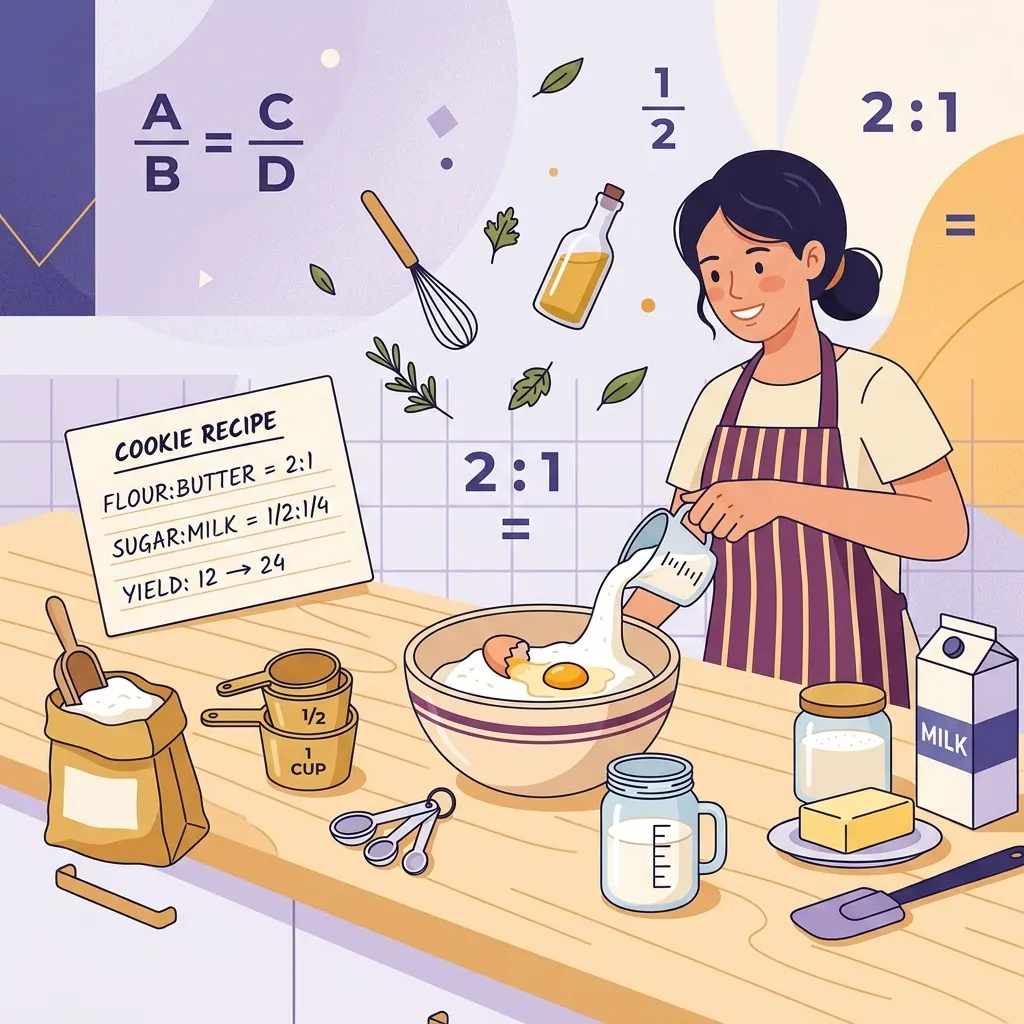
Why Proportions Matter in the Kitchen
Every great cook knows that recipes are really just proportions in disguise. When a recipe calls for 2 cups of flour and 1 cup of sugar, what it’s really saying is that the flour-to-sugar ratio is 2:1. Understanding this principle lets you scale any recipe to any number of servings with perfect results.
Scaling Recipes Up
Imagine you have a cookie recipe that makes 24 cookies, but you need 36 for a party. Here’s how to set up the proportion:
24 cookies / original amount = 36 cookies / new amount
For each ingredient, you’d calculate:
- Original flour: 2 cups → 24/36 = 2/x → x = 3 cups
- Original sugar: 1 cup → 24/36 = 1/x → x = 1.5 cups
- Original butter: 0.5 cups → 24/36 = 0.5/x → x = 0.75 cups
The scaling factor is 36/24 = 1.5, so multiply every ingredient by 1.5.
Scaling Recipes Down
The same principle works in reverse. If a soup recipe serves 8 but you only need to feed 3:
Scaling factor: 3/8 = 0.375
Multiply each ingredient by 0.375. For example:
- 4 cups of broth → 4 × 0.375 = 1.5 cups
- 2 tablespoons of oil → 2 × 0.375 = 0.75 tablespoons
Unit Conversions with Proportions
Proportions are also essential for converting between measurement systems:
- Cups to milliliters: 1 cup / 236.6 mL = x cups / 500 mL
- Ounces to grams: 1 oz / 28.35 g = 8 oz / x g
- Fahrenheit to Celsius: Use the formula, but proportional thinking helps estimate
Quick Conversion Table
| From | To | Proportion |
|---|---|---|
| 1 cup | 236.6 mL | 1/236.6 = x/amount |
| 1 tablespoon | 14.8 mL | 1/14.8 = x/amount |
| 1 ounce | 28.35 g | 1/28.35 = x/amount |
Common Baking Ratios
Professional bakers memorize these fundamental ratios:
- Basic bread: 5 parts flour : 3 parts water (5/3)
- Pie crust: 3 parts flour : 2 parts fat : 1 part water (3:2:1)
- Vinaigrette: 3 parts oil : 1 part vinegar (3/1)
- Pancakes: 2 parts flour : 2 parts liquid : 1 part egg (2:2:1)
Tips for Perfect Recipe Scaling
- Scale by weight, not volume — Weight is more precise, especially for baking
- Don’t scale cooking time linearly — A doubled cake recipe doesn’t need double the baking time
- Watch seasoning carefully — Salt and spices often need less than proportional increases
- Use our calculator — Plug in your original and desired quantities to get exact proportions
Try It Yourself
Next time you need to adjust a recipe, use our Proportions Calculator to get exact measurements instantly. Enter the original quantity, the original yield, and your desired yield — the calculator handles the rest!
Related Articles
- Getting Started with Proportions: A Complete Guide — Learn the math behind recipe scaling
- Cross-Multiplication Explained — Master the technique used in scaling calculations
- How Architects and Engineers Use Proportions Every Day — See proportions shape the built world
- Proportions in Finance: Master Ratios for Smarter Money Decisions — Apply proportional thinking to your finances
Solve your own proportion
Enter any three values in our free proportion calculator and get the missing value with step-by-step cross-multiplication.
Open the Proportion Calculator →Related Articles
Proportions in Finance: Interest, Currency & Tax Ratios
Use proportions to calculate simple interest, compare loans, convert currency, split a portfolio, find ROI and work out sales tax, step by step.
Proportions in Architecture: Scale Drawings & Golden Ratio
How architects use proportions: reading 1:50 blueprints, the golden ratio (1:1.618), material scaling, concrete mix ratios and scale models, with examples.
Proportions in Chemistry: Dilutions (C1V1=C2V2) & Moles
How chemists use proportions for dilutions (C1V1 = C2V2), mole ratios in stoichiometry and weight-based dosing — with clear, step-by-step worked examples.