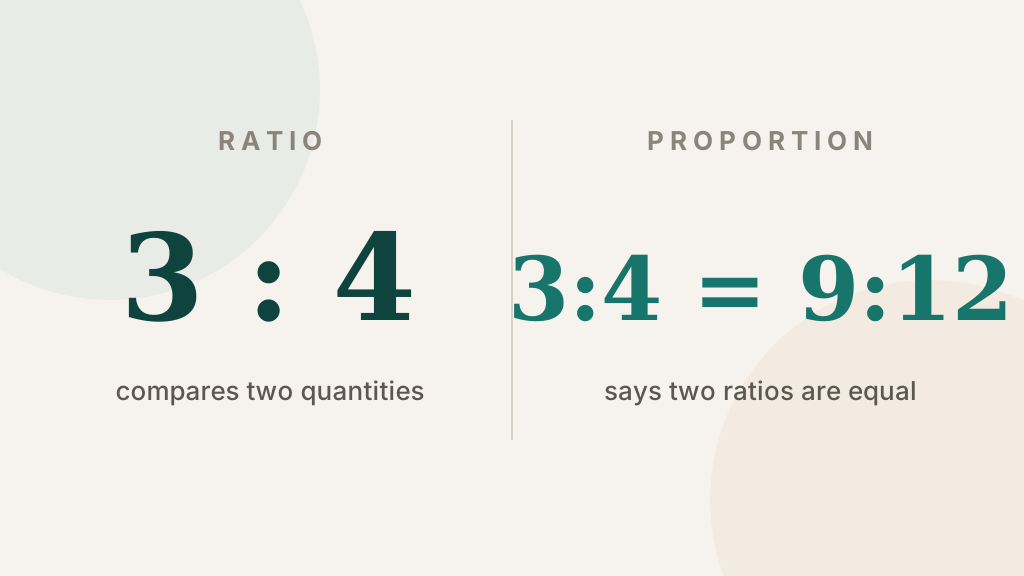
“Ratio” and “proportion” are often used as if they meant the same thing, but in mathematics they’re different objects. A ratio is a comparison. A proportion is a statement that two comparisons are equal. Once that distinction is clear, it’s much easier to see which tool a problem needs.
What Is a Ratio?
A ratio compares two (or more) quantities by division. If a recipe uses 3 cups of flour for every 4 cups of water, the ratio of flour to water is:
- 3 : 4 (colon form)
- 3/4 (fraction form)
- “3 to 4” (word form)
A ratio is a single object, and there’s nothing to “solve” in it. What you do with a ratio is simplify it, scale it or convert it:
- Simplify: 45 : 60 reduces to 3 : 4 by dividing both terms by their greatest common divisor, 15. The simplify ratio calculator does this for up to six terms.
- Scale: multiply every term by the same number to get equivalent ratios: 3 : 4, 6 : 8, 9 : 12 …
- Convert: 3 : 4 is 0.75 as a decimal, and the parts are 42.9% and 57.1% of the whole as percentages.
Ratios can have more than two parts. A concrete mix of cement : sand : gravel = 1 : 2 : 3 is a three-part ratio, and splitting a total in that ratio is a job for the ratio calculator for 3 numbers.
What Is a Proportion?
A proportion is an equation that says two ratios are equal:
a : b = c : d or a/b = c/d
For example, 3 : 4 = 9 : 12 is a true proportion, because both ratios simplify to 3 : 4. Because a proportion is an equation, it can be true or false, and if one term is unknown, it can be solved.
The key fact about every proportion is the cross product rule:
a/b = c/d ⟺ a × d = b × c
That’s how you test a proportion (3 × 12 = 36 and 4 × 9 = 36, so it holds) and how you solve one. In 3/4 = x/12, cross-multiplying gives 4x = 36, so x = 9. The cross multiplication calculator and the main proportion calculator both solve for any missing term with the steps shown. The guide to cross multiplication explains why the rule works.
Ratio vs Proportion at a Glance
A ratio is a comparison of quantities, while a proportion is an equation stating that two ratios are equal. The table compares them on what they are, whether they can be true or false, whether they can be solved, and which calculator each one needs.
| Ratio | Proportion | |
|---|---|---|
| What it is | A comparison of quantities | An equation between two ratios |
| Example | 3 : 4 | 3 : 4 = 9 : 12 |
| Can it be true or false? | No | Yes |
| Can it be solved? | No (simplify, scale, convert) | Yes (cross multiply) |
| Number of terms | 2 or more | 4 (two ratios of 2 terms) |
| Typical tool | Ratio calculator | Proportion calculator |
How to Tell Whether a Problem Needs a Ratio or a Proportion
A problem needs a ratio when it describes one relationship, and a proportion when it says two relationships must match.
Read the question and ask: am I describing one relationship, or saying two relationships match?
- “Write the ratio of boys to girls in a class of 12 boys and 18 girls.” One relationship, so it’s a ratio: 12 : 18 = 2 : 3.
- “If 2 boys for every 3 girls holds across the school, how many girls are there for 240 boys?” Two relationships that must match, so it’s a proportion: 2/3 = 240/x, giving x = 360.
- “Share £450 in the ratio 2 : 3 : 4.” A ratio with a total. Find one part (450 ÷ 9 = 50), then multiply: £100, £150, £200.
- “A map scale is 1 : 50,000. Two towns are 7 cm apart on the map.” A proportion between map and ground distance. See how map scales work or use the scale factor calculator.
Ratio and Proportion Worked Examples
These three worked examples test whether two ratios form a proportion, solve a proportion for an unknown, and turn a known ratio into a proportion to find a missing amount.
Example 1: Is it a proportion?
Do 4 : 6 and 10 : 15 form a proportion?
Cross products: 4 × 15 = 60 and 6 × 10 = 60. They’re equal, so yes. Both ratios simplify to 2 : 3.
Example 2: Solve a proportion
A car uses 5 litres of fuel for 80 km. How much for 200 km?
Set up 5/80 = x/200. Cross multiply: 80x = 1,000, so x = 12.5 litres. This is a direct proportion, because more distance means more fuel. If one quantity went down as the other went up (more workers, fewer days), it would be an inverse proportion instead. See direct vs inverse proportion.
Example 3: Ratio, then proportion
Orange paint is mixed red : yellow = 2 : 5. How much red is needed for 35 litres of yellow?
The ratio is 2 : 5. The proportion is 2/5 = x/35, so 5x = 70 and x = 14 litres of red.
What Does Proportion Mean in Statistics?
In statistics, “proportion” usually means the share of a group with some feature: 42% of households, written p̂ = 0.42. That’s a part-to-whole ratio used for estimation rather than an equation to solve. If you’ve met the word in a statistics class, read what a proportion is in statistics.
Ratio vs Proportion: Key Takeaways
A ratio compares quantities. A proportion states that two ratios are equal. You simplify, scale and convert ratios; you test and solve proportions with cross multiplication. Most real problems use both: they start from a known ratio and set up a proportion to find an unknown amount. For more practice, start with what a proportion is or browse the ratio calculators and proportion calculators.